Copper laser engraving is possible, but achieving consistent results requires more than laser power. Copper’s high reflectivity at common fiber laser wavelengths and excellent thermal conductivity make it more challenging to process than many other metals.
The right laser and settings depend on the application. Surface marking, deep engraving, color marking, and cutting each require different processing strategies.
This guide explains how to laser mark, engrave, and cut copper, compares suitable laser types, and provides practical parameter references for different copper-processing applications.

Why Is Copper Difficult to Laser Engrave?
Copper is challenging to laser process due to its high reflectivity, thermal conductivity, and sensitivity to surface conditions.
1.High Reflectivity at 1064 nm
Copper reflects much of the infrared energy from fiber lasers, making consistent marking and material removal difficult. Reflected energy can also pose equipment and operator safety risks.
2.High Thermal Conductivity
Copper has a thermal conductivity of approximately 394 W/(m·K) at 20°C. Rapid heat dissipation makes localized heating difficult. Excessive power or slow scanning can cause melting, oxidation, spatter, and rough edges.
3.Copper Grade and Surface Condition
Pure copper, oxygen-free copper, electrolytic copper, and copper alloys respond differently to laser processing. Polishing, oxidation, oil, and other contaminants also affect absorption and marking consistency. Identify the material and prepare its surface before developing parameters.

copper brass and bronze
Can You Laser Engrave Copper? And How?
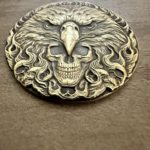
Yes. Depending on the laser system and process, copper can receive surface marks, dark or light contrast marks, shallow engraving, and deeper material removal.
| Process | What it does | Typical applications |
| Laser marking | Changes the appearance or surface condition without necessarily removing much material | Serial numbers, logos, QR codes, identification marks |
| Laser engraving | Removes material to produce a measurable recess | Decorative patterns, dies, tooling, deeper identification |
| Laser color marking | Produces visible colors through controlled surface changes, often involving oxide formation | Decorative logos and selected custom products |
| Laser cutting | Separates material through the full thickness of a workpiece | Thin copper parts, foils, and specialized industrial components |
What is the Best Laser Engraver for Copper Engraving
The best laser for copper depends on the required marking quality, engraving depth, and production speed. Fiber lasers are generally the most practical choice for direct copper marking and deep engraving, while UV lasers may suit fine-detail applications.
Fiber Laser: For Direct Copper Marking and Deep Engraving
Operating typically at 1064 nm, fiber lasers can mark copper, remove material for deeper engraving, and support certain cutting applications. MOPA fiber lasers offer adjustable pulse width and frequency, providing greater flexibility for process optimization.
Which ComMarker Fiber Laser Should You Consider?
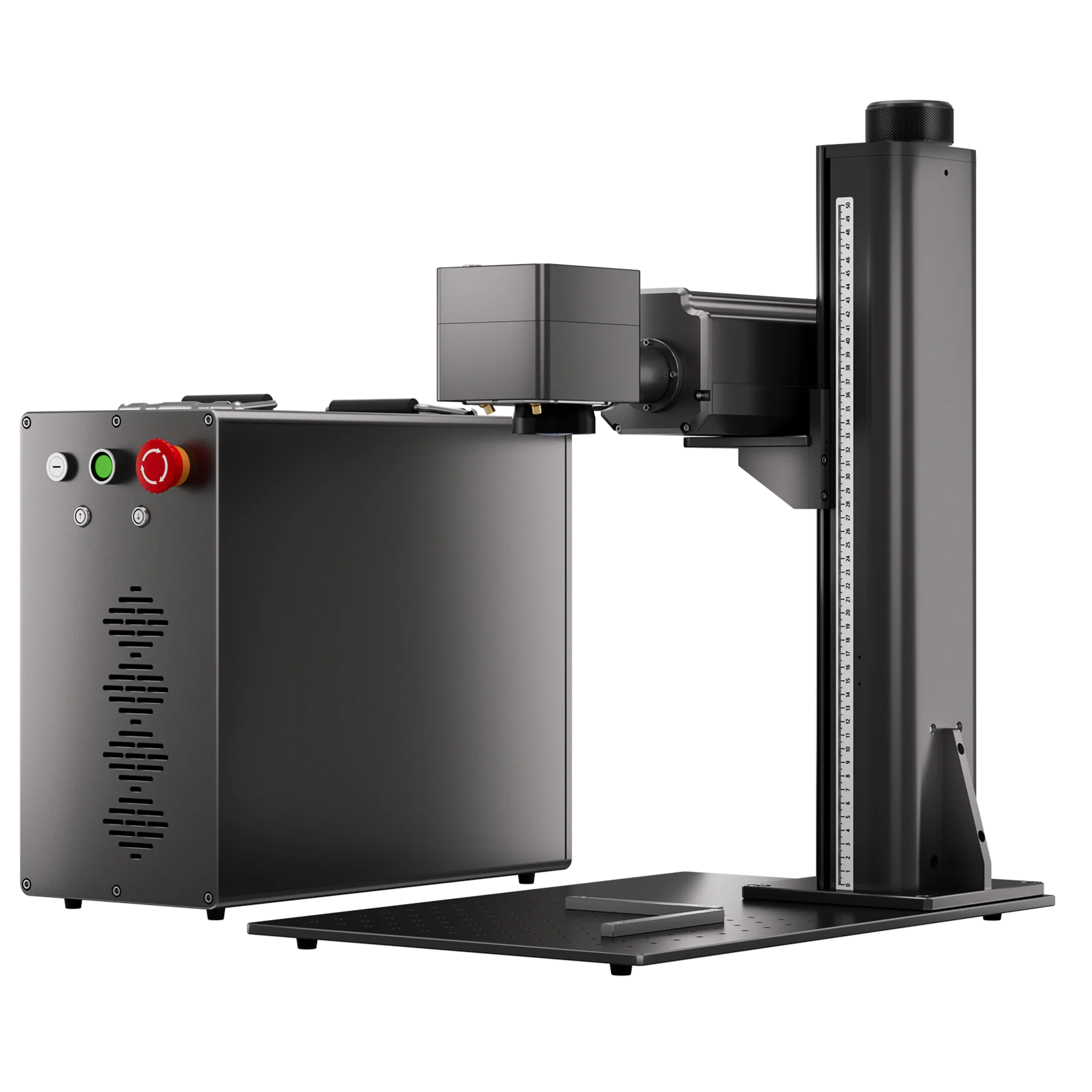
ComMarker B6 60W MOPA: A portable solution for workshops and businesses requiring flexible copper marking, engraving, and material removal.
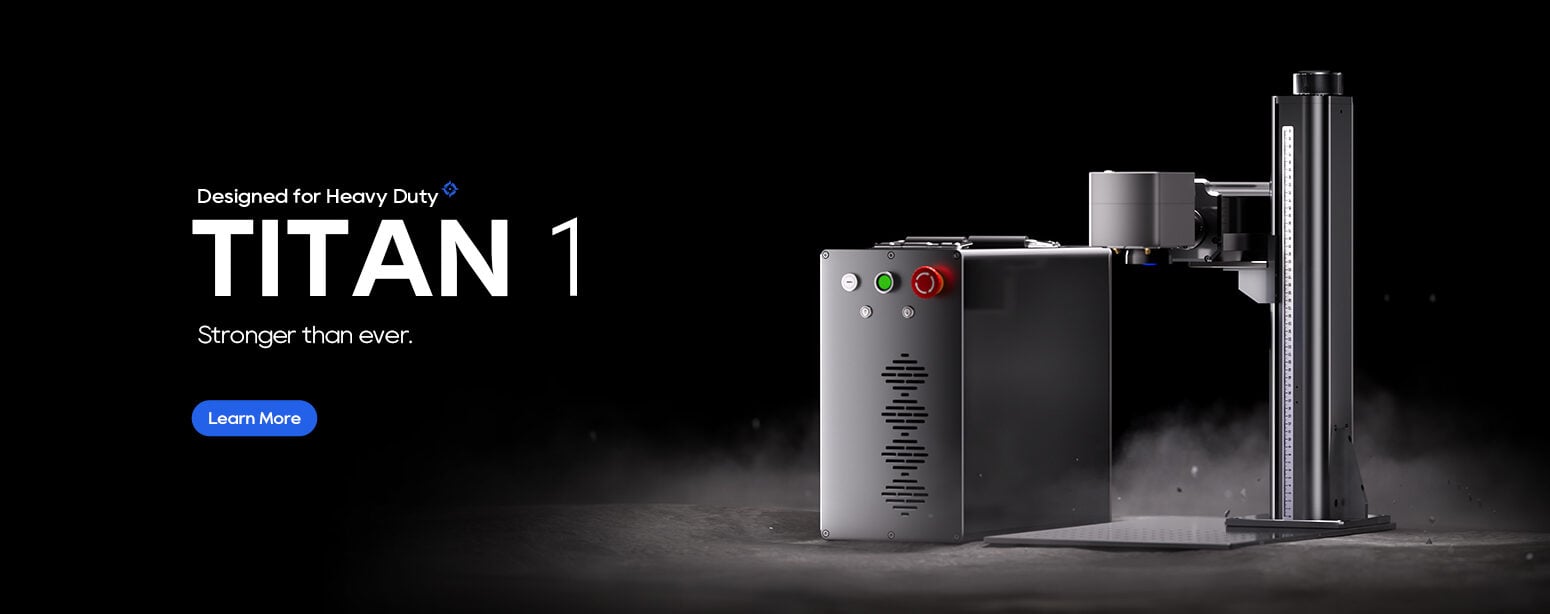
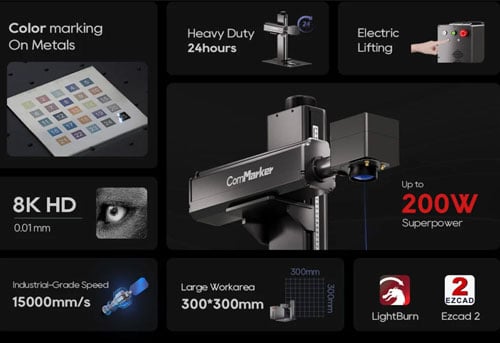
ComMarker Titan 1 MOPA: Available in 60W, 100W, and 200W configurations, offering higher-power options for deeper engraving, thicker material processing, and potentially faster production.
Explore the B6 MOPA and Titan 1 MOPA.
UV Laser: For Fine Details
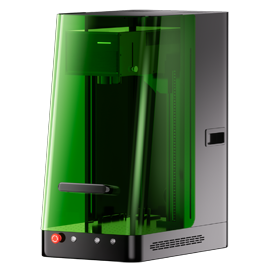
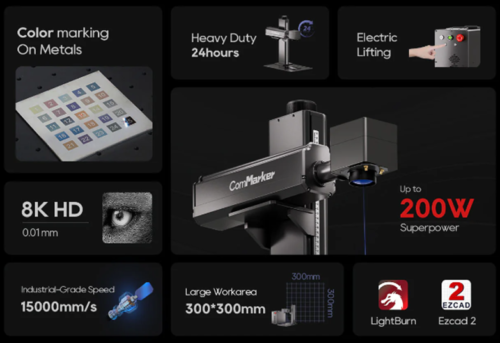
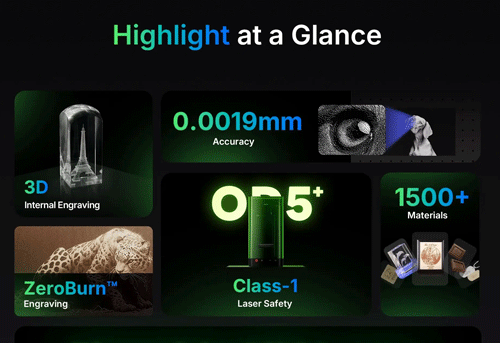
The ComMarker Omni X features a 355 nm UV laser and an ultra-fine 0.0019 mm spot, designed for high-resolution engraving. UV processing may be worth testing for fine-detail copper marking, although results depend on the material and surface condition.
Explore the Omni X UV Laser.
CO₂ and Diode Lasers: Limited for Bare Copper
CO₂ and blue diode lasers are generally better suited to non-metallic materials. For permanent marking, deep engraving, and copper cutting, fiber lasers are usually a more practical choice.
How Key Laser Parameters Affect Copper Laser Engraving
Understanding the key parameters below provides a starting point for optimizing copper laser engraving settings.
Power
Copper requires sufficient laser power to reach the melting point or oxidation threshold. Excessive power can cause over-melting, burn-through, or heavy spatter, resulting in rough marking edges.
Frequency
Deep engraving on copper typically benefits from lower frequencies, which deliver higher pulse energy. A suggested range is 20–40 kHz, with deep engraving sometimes using as low as 20–30 kHz. For high-contrast marking, such as white marking, higher frequencies—potentially above 200 kHz—may be used.
Marking Speed
Copper conducts heat rapidly, dissipating energy quickly. Relatively slower marking speeds can help ensure sufficient energy is absorbed by the surface. Some parameter guides recommend speeds of 300–500 mm/s for copper marking.
Fill Spacing (Hatch Distance)
A general starting range for fill spacing is 0.01–0.03 mm. For pure copper, some parameter charts recommend a hatch distance of 0.02 mm.
Pulse Width (Pulse Duration)
Shorter pulse widths, such as 10–20 ns, may be used for fine-detail marking. Studies also compare pulse widths of 100 ns and 200 ns to evaluate their effects on marking contrast.
Fill Direction
Unidirectional filling: Tends to produce black marks by forming an oxide layer that absorbs light.
Cross-hatch filling: Tends to produce white marks by creating microscopic surface roughness that scatters light.
Laser Mark Copper Settings
ComMarker B6 MOPA 60W MOPA Fiber Laser
| Application | Speed | Power | Frequency | Line spacing |
| Black marking | 300 mm/s | 98% | 40 kHz | 0.01 mm |
Confirm the source configuration and test the actual copper workpiece.
How to Laser Deep Engrave Copper?
Why it’s difficult
Copper’s high reflectivity and thermal conductivity make efficient material removal difficult.
Heat dissipates quickly, while molten copper can accumulate in the groove and resolidify as reflective dross.
As a result, simply increasing the number of passes may cause copper buildup rather than greater engraving depth.
How to deep engrave copper effectively
Method 1: Double-Hatch Strategy for Controlled Material Removal
For the main hatching process, employ high energy density: slow scan speed, high power, low frequency, small hatch spacing, and a cross-hatch or multi-angle scanning strategy.
After each layer, incorporate a rapid cleaning pass: use a higher scan speed, lower power, higher frequency, larger hatch spacing, and a different scan angle.
| Pass | 20W Fiber Laser Setting-110 mm lens |
| Main | 700 mm/s, 50%, 50 kHz, 0.03 mm spacing, 45°, cross-hatch ON, pattern changed |
| First clean | 500 mm/s, 50%, 35 kHz, 0.03 mm spacing, 270°, cross-hatch ON, pattern changed |
| Second clean | 1000 mm/s, 40%, 50 kHz, 0.05 mm spacing, 90°, cross-hatch OFF |
| Cycle | 8 repetitions |
| Result | 0.0115 in (0.29 mm) |
Method 2: A Simpler Alternative
If you prefer to avoid a multi-stage engraving process with multiple cleaning passes, the following 50W fiber laser settings offer an alternative starting point.
| Machine (Y-axis) | Speed (mm/s) | Power (%) | Frequency(kHz) | Line Interval | Wobble | Cross-Hatch |
| 50W fiber laser-110mm lens | 300 | 95 | 37 | 0.02 mm | OFF | OFF |

How to Color Mark Copper with a MOPA Fiber Laser
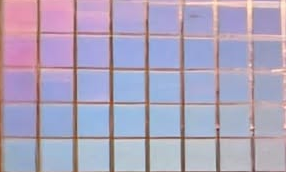
Laser color marking on copper is possible under specific processing conditions, although the range of achievable colors is generally more limited than on stainless steel. Certain tested parameter combinations may produce pink, blue, or other color effects.
A MOPA fiber laser provides adjustable pulse-width and frequency control, offering more flexibility when developing color-marking parameters.
ComMarker Titan 60w Mopa Fiber Laser Engraver Settings for color laser engraving copper.
Speed 800 mm/s;Power 60%;Q pulse 8.Interval 0.01,Frequency from 250-950 khz (Pink to Blue)
For a broader explanation of pulse control and color-marking methods, see the MOPA Laser Color Engraving Guide.
How to Laser Cut Copper?
Wobble vs. Offset Scanning
Wobble scanning is not always the most efficient strategy for copper cutting. Circular scanning paths can concentrate energy along the perimeter of the wobble pattern rather than distributing it evenly across the cutting path. This may limit efficiency when processing highly reflective, highly thermally conductive copper.
Offset-based scanning is an alternative worth considering. By controlling the spacing between passes, it allows more flexible energy distribution and heat management during cutting.
Unlike deep engraving, copper cutting does not require densely packed hatch lines. Increasing line spacing appropriately can help reduce excessive heat input, improve molten material removal, and increase processing efficiency.
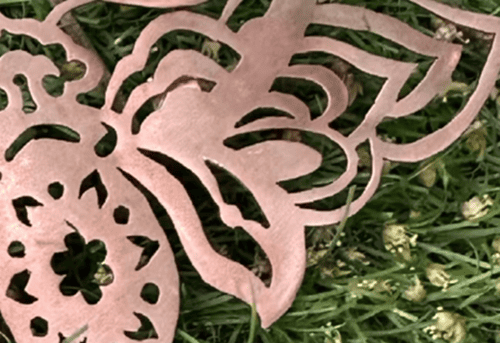
Copper cutting can be relatively slow. For example, cutting 2 mm copper with a 30W fiber laser may require up to 200 passes, depending on the material and processing conditions. For faster cutting and improved production efficiency, consider a higher-power fiber laser engraver, such as the ComMarker Titan 1, available in 60W, 100W, and 200W configurations.
Fiber laser copper cutting settings:
| Machine (Y-axis) | Speed (mm/s) | Power (%) | Frequency(kHz) | Fill / Strategy | Line Interval | Wobble | Cross-Hatch | Offset |
| ComMarker B4 20W | 100 | 70 | 20 | Offset cutting | N/A | N/A | N/A | 0.3 mm |
| 50W Fiber Laser Engraver | 100 | 90 | 37 | Offset cutting | 0.020 mm | ON (Step 0.08 / Size 0.1) | OFF | 0.3 mm |
Common Copper Laser Engraving Problems and How to Fix Them
Weak/no mark or cut: Copper reflects most energy. Use pulsed high-energy pre-heating, raise power/lower speed, clean the surface, or apply black marker/marking spray.
Deep engraving edges are rough: Increasing frequency and lowering pulse width can help get a smoother background. It takes a little longer to engrave.
Dross/incomplete cut: Molten material is not ejected. Increase passes to 200+, set negative focus (-1 to -2 mm), and check gas pressure/nozzle alignment.
Inconsistent cut: The process window is narrow. Verify focus and clean lens/nozzle, keep the surface clean, clamp the workpiece securely, and tune one parameter at a time.
Copper vs Brass vs Bronze: What’s the Difference: Not all copper behaves the same. Brass and bronze are much easier to engrave due to lower reflectivity and better energy absorption.
| Property | Bronze (Tin / Phosphor Bronze) | Copper (Pure Copper) | Brass (Copper + Zinc) |
| Reflectivity (High → Low) | 62% ~ 68% | 93% ~ 96% (Highest) | 70% ~ 78% |
| Thermal Conductivity (Fast → Slow) | 70 ~ 85 W/m·K | 401 W/m·K (Fastest) | 110 ~ 120 W/m·K |
| Composition & Behavior | Cu + Sn / P: oxidizes to brown/black, matte finish | Pure Cu: hard to oxidize, hard to blacken | Cu + Zn: zinc vaporizes easily, produces deep black marks |
| Visual Result | Matte antique bronze black, uniform result, clean edges, durable | Dark dull brown/black, low contrast, clean edge | Bright dark black, ultra-high contrast, but may produce burrs and smoke |
| Laser Engraving Difficulty | Easy | Difficult | Very Easy |
Copper Laser Engraving Applications
Copper laser marking and engraving can support several applications, depending on the required mark quality and depth.
Jewelry and personalized gifts: Names, decorative patterns, logos, and surface details on suitable copper items.
Electrical components: Identification marks, part numbers, and traceability information where the process meets the component’s requirements.
Industrial tags and identification plates: Text, serial numbers, and other permanent identification marks.
Tooling and electrodes: Recessed features and identification on suitable copper workpieces, subject to the required geometry and dimensional tolerance.
Custom products: Logos, branding, and decorative marks for small businesses and product manufacturers.
Laser Safety When Processing Copper
Eye safety: Copper is highly reflective—use a properly enclosed system with interlocks and wavelength-appropriate protection; don’t rely on protective eyewear alone.
Fume extraction: Use suitable extraction/filtration for copper and any coatings, plating, or contaminants—don’t assume it’s safe just because the first few passes look fine.
Final Takeaways
Laser engraving copper requires careful consideration of the material, laser source, and processing parameters.
Fiber lasers, particularly MOPA models, offer flexibility for copper marking and engraving, while higher-power configurations can help improve processing efficiency in demanding applications. UV lasers may also be worth testing for fine-detail work.
The right choice depends on the copper grade, thickness, surface condition, and desired result.
Always test on a sample before production. Explore ComMarker’s B6 MOPA, Titan 1 MOPA, and Omni X UV laser engravers to find a solution suited to your metal-processing needs.